Tarot: Can 78 Cards Really Tell You Anything About Your Life?
Can Tarot predict the future? Will I marry this man? Will my business succeed? When will I finally become rich?
These are probably some of the most common questions people bring to Tarot readers. And quite often, they are the very questions that need to be reformulated before we can get anywhere.
I was taught a fairly systematic approach to Tarot. There is a certain logic to how the cards work, what information we can expect from them and how we should formulate our questions. And the more I study and practise, the more fascinating I find this system.
How Tarot Works With the Future
In the esoteric tradition I follow, we work with the concept of branches of probability.
At any given moment, your circumstances, decisions, behaviour and relationships are creating certain possibilities for the future. Some are already developing, others are still very remote. Every significant decision can change their relative likelihood.
Through Tarot, we attempt to examine the probabilities that have already taken shape and where they are likely to lead.
Let’s say you are having problems with your partner. You ask about the future of your relationship, and the cards indicate a separation within three months. Naturally, that’s not the answer anyone wants to hear. But before you start packing your suitcases, there is more work to do. We can investigate what is causing the problem, how your partner is likely to behave, whether there is anything you could change and how different actions might influence the outcome. Perhaps the relationship is indeed approaching its end. Or perhaps there is an opportunity to resolve the conflict that you haven’t considered.
This is one of the reasons I find Tarot so useful. Having some idea of where things are heading gives us an opportunity to reconsider our actions while there is still time.
There are, however, limitations. In my practice, I generally don’t use Tarot to forecast events more than a year ahead. Too many circumstances can change along the way.
And I wouldn’t attempt to predict the exact date of your wedding if you are currently single, have no prospective partner and aren’t even planning to date. There is simply no sufficiently developed situation to investigate.
For broader questions about life direction, I prefer other esoteric methods.
Why the Question Matters
Imagine you’re considering moving abroad and have three countries in mind: Portugal, Italy and France.
You ask: “Where should I move?”
How exactly are the cards supposed to identify these geographical locations? Unless we agree beforehand which card or position represents which country, the answer becomes unnecessarily ambiguous. I would rather examine the prospects of moving to each country separately, including possible opportunities, obstacles and developments within a specified period.
The same applies to relationships.
“What does he think about me, how does he feel and what will he do?”
Three perfectly reasonable questions. But they are three different questions, requiring separate answers.
And please, let’s be careful with words like forever, never, destiny and soulmate. What does “Is he my destined partner?” actually mean? Are you asking whether you’ll marry him, whether the relationship will last, or whether there is some spiritual significance to your connection?
We need to understand what you really want to know.
None of this means that you must arrive at a consultation knowing how to formulate a perfect Tarot question. Helping you do that is part of my job.
Carl Jung and the Mystery of Synchronicity
Now, for those who are interested in a more intellectual explanation, Tarot has a fascinating connection to analytical psychology.
Carl Gustav Jung, the famous Swiss psychiatrist, studied archetypes — recurring symbolic patterns found in human psychology, mythology, religions and dreams. In a seminar in 1933, he discussed Tarot as a collection of images representing archetypal situations.
He was also interested in divination and developed the concept of synchronicity, describing coincidences connected by meaning rather than a conventional cause-and-effect relationship.
Here’s a simple example.
You haven’t thought about an old friend for years. One morning, for no apparent reason, this person suddenly comes to mind. A few hours later, you receive a message from them.
Most people would call it a coincidence. Jung was interested in whether some such coincidences might reflect a deeper connection between psychological experience and external events.
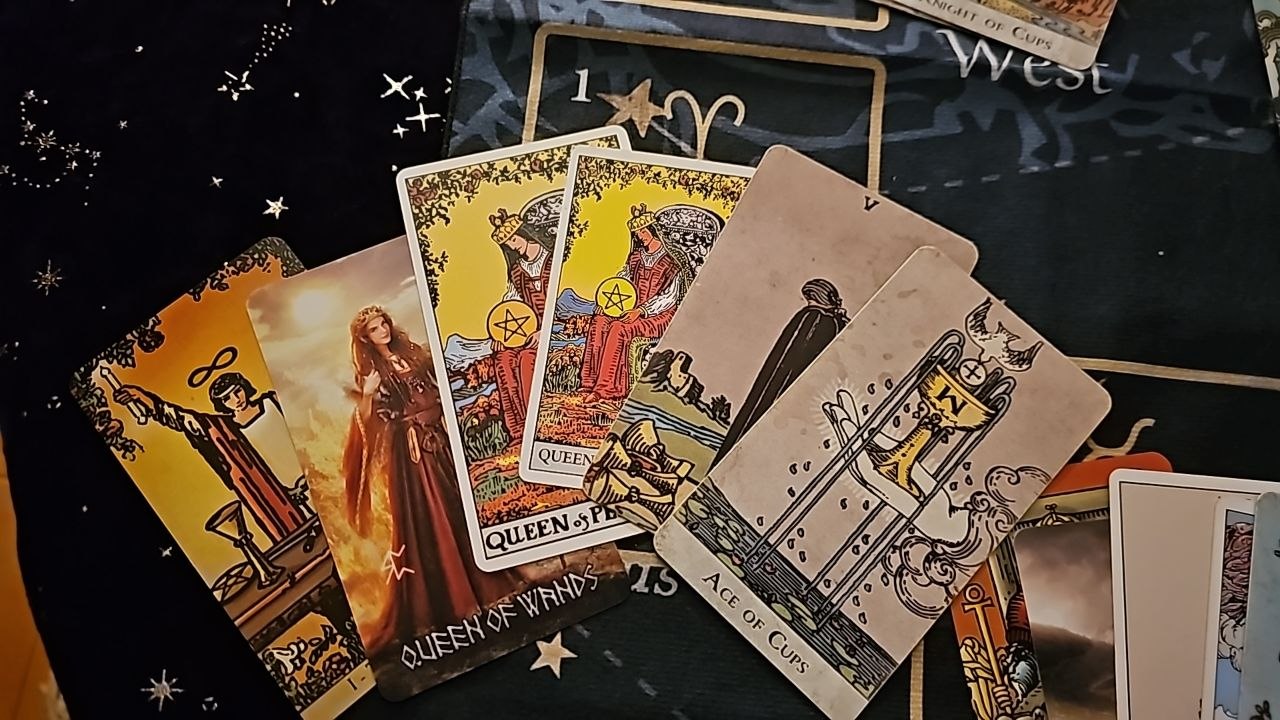
Now consider Tarot. You formulate a question, shuffle a deck of 78 cards and draw a particular combination. Sometimes the relevance of those cards to the situation is quite extraordinary.
Why this combination, at this particular moment? Jung’s theory offers an interesting perspective, although synchronicity has not been scientifically established as an explanation for divination.
And this is where I have my own opinion. I believe Tarot can provide information beyond what could be reasonably inferred from psychological analysis alone.

What I Wouldn’t Trust Tarot With
I would certainly not use Tarot for medical diagnoses, nor would I rely on it as the sole basis for serious financial or legal decisions.
I would also be cautious about claims of reading another person’s mind with absolute certainty. Cards can suggest possible feelings, intentions and behaviour, but those interpretations are not verified facts.
And if a Tarot reader announces that you are suffering from a terrible curse and immediately offers to remove it for a substantial fee, I would strongly recommend looking for another specialist.
There is also the question of the reader’s competence. Learning the meanings of 78 cards is relatively straightforward. Interpreting their combinations, understanding the question, selecting an appropriate spread and identifying a coherent scenario require considerably more study and practice.
Knowledge of human psychology is particularly valuable here. People are complicated, their motivations frequently contradict their actions, and similar situations may have completely different underlying causes.
I take this work seriously and don’t rely on intuition alone.
I prefer a clear question, a careful interpretation and recommendations that can be put into practice.
You are welcome to approach Tarot with curiosity, scepticism or both. We can start with a specific situation and a single reading. And if the cards suggest something unexpected, we can investigate it further. That’s often where things become particularly interesting.
Book your Clarity Reading here →
Latest News